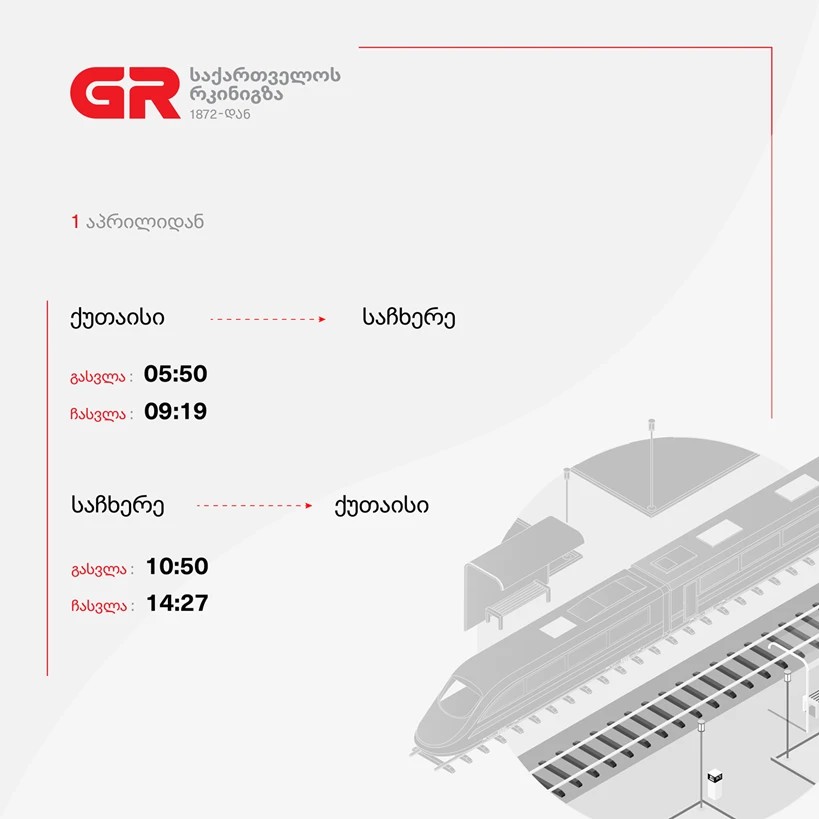
Tbilisi (GBC) – Georgian Railways will operate an electric train on the Kutaisi-Sachkhere-Kutaisi route from April 1, the railway announced.

1774607950

Tbilisi (GBC) – Georgian Railways will operate an electric train on the Kutaisi-Sachkhere-Kutaisi route from April 1, the railway announced.
სიახლეები ამავე კატეგორიიდან

In 2025, the largest number of live births was recorded in Tbilisi (14 334) while the smallest – in Racha-Lechkhumi and Kvemo Svaneti Region (191).Compared to 2024, in 2025 the share of the first order births in total live births increased from 35.9 percent to 36.6 percent. The share of the second child decreased and equaled 32.9, while the share of the third and next order births remained almost unchanged and equaled 29.1 percent.Compared to 2024, in 2025 the share of live births for women aged 25-39 increased (from 69.5 percent to 70.4 percent) and decreased for women aged less than 25 (from 23.2 percent to 21.9 percent), while increasing for women aged 40 years and older (from 7.3 percent to 7.7 percent).In 2025, the number of deaths increased by 0.8 percent in annual terms and totaled 44 319 persons. The largest number of deaths was recorded in Tbilisi (12 743) while the smallest – in Racha-Lechkhumi and Kvemo Svaneti Region (585).According to the 2025 data, infant mortality rate (per 1 000 live births) equaled 7.6 ‰. The under-5 mortality rate (per 1 000 live births) in 2025 totaled 9.1‰.According to the 2025 data, the negative natural increase was stated in Georgia (the difference between the number of live births and the number of deaths) equaling -6 452. A negative natural increase was registered in all regions except Tbilisi, Adjara A.R. and Kvemo Kartli region.In 2025, 22 285 marriages have been registered, which is a 2.9 percent increase from the corresponding figure of the previous year. The mean age of first marriage in 2025 equals 30.1 years for females and 32.4 years for males.The number of divorces in 2025 equaled 13 173 decreasing by 2.6 percent compared to the previous year.
1774608061
Open Banking allows users to decide who they share their financial data with, when, and to what extent, while also enabling them to securely initiate payments from their preferred platforms. Data sharing and related services are carried out via standardized APIs, based on the user’s explicit and informed consent.The development of a modern digital financial ecosystem is one of the key priorities of the National Bank of Georgia (NBG), with Open Banking at its core. The foundation for this infrastructure was laid in the summer of 2019, followed by the establishment of a standardized framework that ensured the availability of account information sharing and payment initiation services through secure API channels. The system became operational in 2021, when commercial banks joined and began offering customers new products based on these services. In July 2024, the ecosystem expanded beyond the traditional banking sector. At that point, the first non-bank entity was authorized by the NBG to participate in Open Banking.Key indicators from the past year highlight this upward trend: 915,000+ transactions have been initiated through Open Banking. This reflects growing user trust in fast and secure payment methods and confirms that Open Banking is becoming an integral part of everyday financial life. 5,000+ uses of account information, payment initiation, and digital onboarding services. This reflects stable demand for innovative solutions that enable users to manage and control their finances more efficiently. 9.3 million+ total uses of Open Banking services. This scale demonstrates that the system has evolved into a solid and reliable foundation, ensuring the seamless operation of everyday digital financial services. Business interest in Open Banking opportunities is growing significantly. The ecosystem is not limited to traditional financial institutions and fintech companies it also creates new opportunities for the broader business sector, including retail and e-commerce.Both regulated entities of the NBG and organizations that were not previously subject to its supervision can participate in Open Banking. Upon meeting the relevant requirements, retail and other non-financial sector companies are able to provide Account Information Services (AIS) and Payment Initiation Services (PIS). In practice, this means that businesses can directly implement modern, fast payment methods on their own platforms. Since a transaction initiated through Open Banking is essentially an Account-to-Account payment, it significantly reduces the need for traditional intermediaries. As a result, businesses benefit from the advantages of an open ecosystem lower operational costs and increased security.For detailed information on the integration of Open Banking in e-commerce and the new advantages created for businesses, please refer to the NBG’s article: Open Banking in E-commerce: New Opportunities and Development Perspectives.Organizations wishing to join Open Banking should follow the “Regulation on Joining Open Banking.” Additional information on the regulatory framework is available on the website of the National Bank of Georgia.Those interested in Open Banking can contact the Innovation Office of the National Bank of Georgia at: innovationoffice@nbg.gov.ge.
1774607787
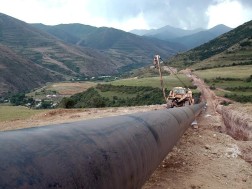
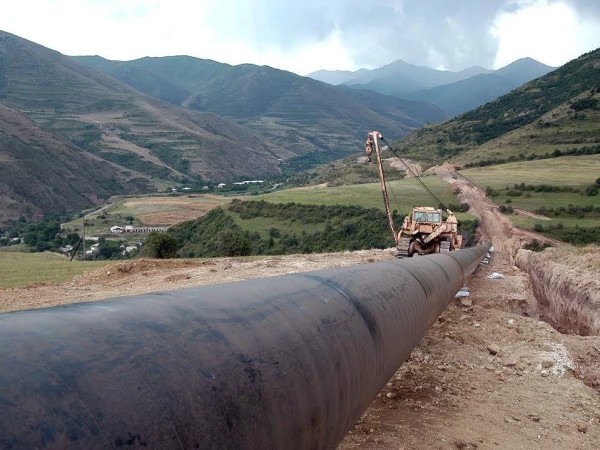
According to the documentation, the change in the location of the gas pipeline is related to the request of the Armenian side, since the Armenian section of the pipeline is located in the trilateral border zone of Georgia, Armenia, and Azerbaijan and was mined in the 1990s.According to the justification for the relocation, based on the fact that it is impossible to maintain minimum safety standards and carry out repair work on the given section, it was decided to remove the problematic section of the gas pipeline from the mined zone and build a new pipeline at a safe distance, based on a trilateral intergovernmental agreement.The gas pipeline will be moved several kilometers and will connect to a new pipeline laid by the Armenian side.
1774607634
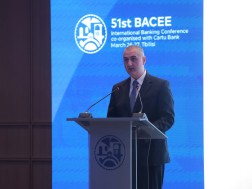
The Minister reviewed the latest macroeconomic indicators in detail and noted that in recent years Georgia has demonstrated resilience to various shocks and fiscal stability, as a result of which the average economic growth over the past five years amounted to 9.3%, while the medium-term forecast remains within 5%.According to Lasha Khutsishvili, per capita GDP has increased significantly and reached $31,000 in purchasing power parity, while the structure of the economy has become more focused towards services, including information technologies, tourism and education.Speaking about the fiscal sector, the Minister highlighted the sharp reduction in the deficit from 9.2% in 2020 to 1.4% in 2025, while the state debt ratio has reached 34% of GDP, which is significantly lower than the 60% limit set by law.Lasha Khutsishvili also noted in his speech that 93% of external debt is concessional loans from international institutions and the Ministry pays special attention to the development of the government securities market, for which new instruments are being developed to simplify access for non-resident investors.The Minister confirmed the Government’s commitment to the reform agenda, which includes the capital market, state-owned enterprises, tax administration and energy security, which will ultimately ensure the long-term sustainability of the country and the well-being of its citizens.
1774607239
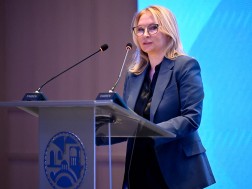
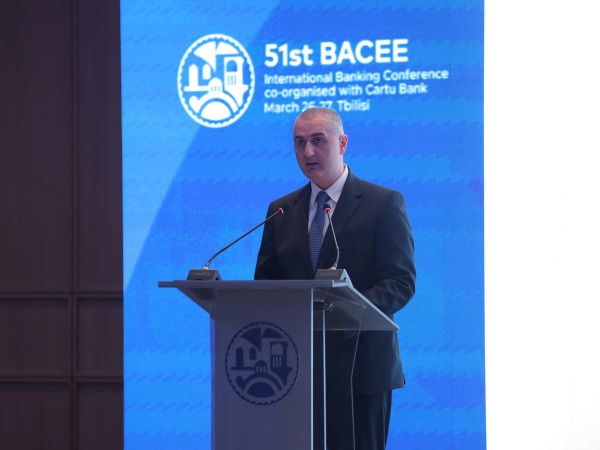
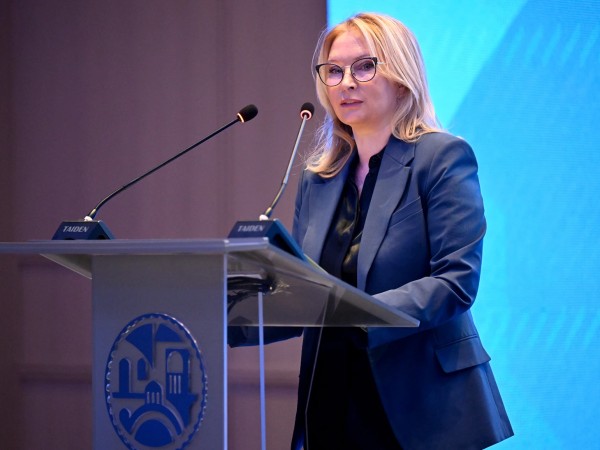
The event is attended by more than 250 delegates from 30 countries and 100 different institutions.As Natia Turnava noted in her speech, holding an event of this scale in Georgia once again emphasizes the growing role of Georgia as a financial center of the region.According to her, this interest is based on the country's strong macroeconomic fundamentals and a solid financial sector. According to Natia Turnava, over the past few years, despite the highly uncertain global environment, the Georgian economy has maintained stability. Real GDP growth has been strong; it reached almost double digits in 2023-2024, and averaged 7.5% in 2025.“Georgia’s banking system remains solid and resilient, well-capitalized, maintains strong liquidity buffers, and demonstrates solid profitability. As of February 2026, return on equity stood at 22.4%, while asset quality remains high. The non-performing loan ratio remains at a historically low level of only 2.47%. Credit activity continues to expand in line with economic growth. In February 2026, the annual growth rate of the credit portfolio reached 14.3%, mainly driven by lending in the national currency,” the NBG President noted, underlining the increased confidence in the national currency, which is supported by the increased rate of larization.According to the President of NBG, a strong financial sector, supported by a modern regulatory framework, attracts the interest of international investors, and these efforts are recognized internationally."S&P Global Ratings" emphasizes that Georgia's banking regulation is one of the most advanced in the region, and the quality of our assets is among the best. The strong indicators of the financial sector, together with solid macroeconomic fundamentals and an open, business-friendly environment, create a supportive foundation for international investors and companies, and we welcome global players to our market," - noted Natia Turnava.
1774607156
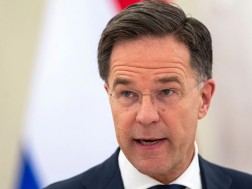
According to NATO Secretary General Mark Rutte, NATO believes it is important to maintain its relationship with Georgia, despite concerns over recent developments.“When it comes to the relationship between NATO and Georgia, we think there is merit in keeping that relationship going. It is better to keep the relationship going and have an avenue to discuss those issues than to say we end the relationship,” Mark Rutte said.Responding to a question about developments in Georgia after the 2024 elections, Rutte noted that NATO is closely coordinating its approach with the European Union.“First of all, when it comes to Georgia, obviously, we coordinate closely with the European Union.When it comes to the relationship between NATO and Georgia, we think there is merit in keeping that relationship going. But, of course, we also have to recognize recent developments, and that’s why we call upon Georgia to return to the path of a more pro-EU, European, forward-looking approach, including making sure that all the developments, and let’s say the whole trajectory Georgia was on in terms of democracy, rule of law, is continued.Obviously, there are serious worries at the moment. So, we have the dialogue, we have the discussion, but we have taken the position that it is better to keep the relationship going and then have that avenue to discuss those issues than to say, ‘Hey, we don’t like it, we end the relationship altogether’,” NATO Secretary General stated.
1774585620

In February, compared to the previous month, term deposits increased by GEL 1.22 billion, or 3.85% (excluding the exchange rate effect, they increased by 4.13%), while demand deposits decreased by GEL 190.36 million, or 0.54% (excluding the exchange rate effect, they decreased by 0.09%).According to the NBG, the larization coefficient of deposits amounted to 54.03% as of the end of February 2026. Compared to the end of the previous month, the larization of deposits increased by 1.41 pp (excluding the exchange rate effect, it increased by 1.21 pp).In February, the average annual weighted market interest rate on term deposits amounted to 7.17%. Among them, 9.14% was on deposits placed in national currency, and 2.35% on deposits placed in foreign currency.The share of US dollars in deposits placed in foreign currency was 77.62%, and the share of EUR was 20.46%.
1774526714

During the same period, compared to the previous month, the volume of loans issued in the national currency increased by GEL 530.64 million (1.31%), while the volume of loans issued in foreign currency increased by GEL 123.99 million (0.41%) (excluding the exchange rate effect, increased by 1.32%).At the end of February 2026, commercial banks had issued loans to resident legal entities in the national currency of GEL 10.77 billion (0.81% more than the previous month), and in foreign currency of GEL 20.31 billion (0.39% more than the previous month) (excluding the exchange rate effect, increased by 1.27%).According to the data, during February 2026, the volume of lending to the resident household sector increased by 0.95%, or GEL 351.47 million, and amounted to GEL 37.17 billion by the end of February.In addition, by the end of February 2026, the larization ratio of total loans amounted to 57.78%. Compared to the end of the previous month, it increased by 0.22 pp. (unchanged after excluding the exchange rate effect).
1774526658
Georgia’s Fruit Yields Are Two Times Less Than The EU Average – Galt &...
1773818621
Committee supports 3-fold increase of excise duty on cars older than 6...
1773739140
Foreign trade decreased by almost 7%. Exports increased by 23%
1773399302
Natia Turnava Met with Bybit CEO
1773398942
Shares of all three Georgian companies listed on the London Stock Exch...
1773662087