

"Wine isn’t about memorising facts or impressing anyone. It’s about curiosity, enjoyment, and building confidence, one glass at a time," -
Paul Declerck
Tbilisi (GBC) - Ever since the National Wine Agency of Georgia introduced a mandatory organoleptic evaluation and a 1.5-point minimum threshold for export certification, debate across the country’s wine sector has renewed. From the regulator's perspective, the logic is purely pragmatic: safeguard market integrity against low-quality or contaminated bottles. Yet, for small-scale and artisanal producers-particularly those devoted to experimental skin-contact, Qvevri, and natural winemaking-a critical question emerges: could this rigid administrative filter turn into a bureaucratic barrier?
As the domestic market adapts to these shifting rules, the global wine community continues to debate the true purpose of evaluation scores: are they meant to act as punitive gatekeepers, or as tools for consumer engagement and education?
To contextualize this dilemma, we spoke with wine expert Paul Declerck, author of How to Appreciate Wine. Raised in France’s Loire Valley among a family of winemakers, Declerck developed his 5-point evaluation framework precisely to strip away academic snobbery and unnecessary intimidation from wine tasting.
“When you hand someone a glass of wine, almost anyone can tell you if they like it, but hardly anyone can explain why,” Declerck observes. “It often comes down to aromas, texture, viscosity, or acidity, but novice tasters lack the vocabulary to separate those elements. The 5-point approach gives beginners a clear structure so they know what to focus on and can assess wine purely on its structural merits.”
“Taste Is Subjective; Quality Is Objective”
One of the most persistent dogmas in the wine world is that taste is entirely subjective. Declerck, however, draws a firm line between personal preference and structural quality.
“People often say taste is subjective, and that’s true-broccoli will taste very different prepared at home compared to a dish executed by a three-star Michelin chef,” Declerck explains. “So my answer is: yes, taste is subjective, but quality is objective. Quality represents a standard that applies to any crafted product, and that is precisely what we aim to measure.”
This distinction carries particular relevance for Georgian tasting panels and everyday consumers alike, where personal bias frequently gets conflated with technical balance. The core objective of the 5-point method is to set individual preferences aside and focus on a wine’s structural architecture - its balance, intensity, length, and complexity.
The Qvevri Goes Global: Universal Standards for Ancient Vessels
Traditional qvevri and amphora wines fermented on the skins, once viewed as a niche Caucasian curiosity, have firmly integrated into the global winemaking lexicon. Today, European producers are increasingly adopting clay vessels in their own cellars.
“You now see traditional clay amphoras and qvevri in cellars across the globe; I’ve personally observed them in Champagne, Burgundy, and Bordeaux,” Declerck notes. “Winemakers often experiment with them over a few vintages before fully committing. As we know, the wine industry evolves slowly, and adopting new practices takes time.”
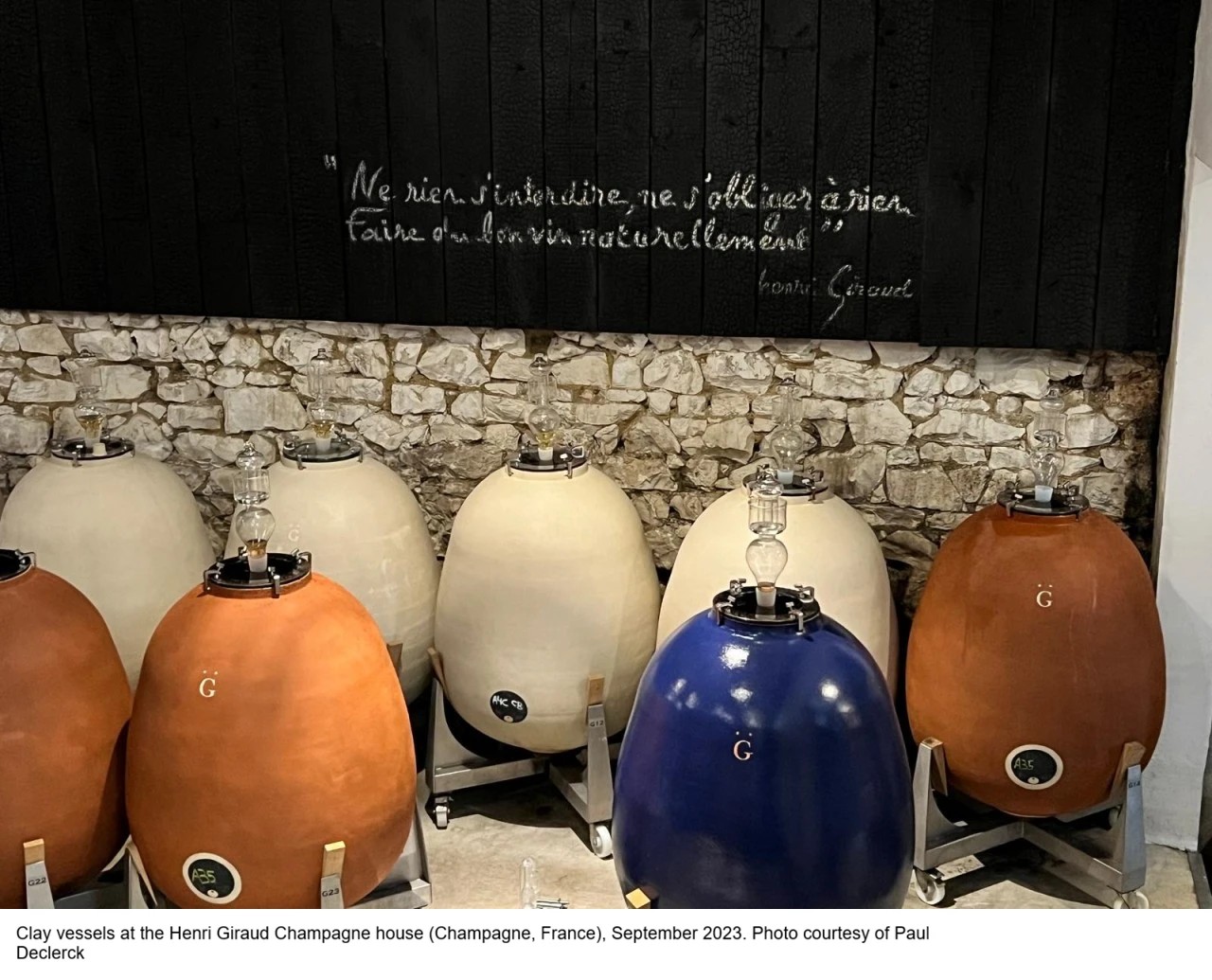
From an oenological perspective, Declerck attributes the appeal of clay vessels to their physical and chemical dynamic: the porous nature and rounded shape of the vessel encourage natural micro-oxygenation and convection currents, achieving naturally what oak barrels or stainless-steel tanks require manual pumps or lees-stirring (bâtonnage) to accomplish.
Yet, as these artisanal, high-tannin, skin-contact wines gain traction in international markets, they raise a pressing question: how should products that defy traditional tasting grids be evaluated?
Declerck argues that an objective evaluation framework must remain universal:
“My 5-point method is universal-it applies equally to reds, whites, rosés, champagnes, skin-contact orange wines, light-bodied, or full-bodied styles. It won't instantly make you a seasoned expert capable of spotting every nuance of Qvevri aging, but it gives you a far clearer grasp of what structural quality actually means.”
For Georgian exporters navigating Western markets, this approach is crucial. When international consumers encounter artisanal Georgian wines, evaluation metrics shouldn't confuse them. Instead, a universal scoring model helps buyers recognize firm Qvevri tannins and skin-contact extraction not as faults, but as essential structural components of quality.
The Point Trap in Wine Commerce: Lessons from Robert Parker
In commercial wine buying, retail chains, and sommelier networks, 100-point scales have long dominated purchasing decisions. However, when buyers and importers rely solely on numerical ratings, they risk misreading what the market actually wants.
“The biggest mistake trade buyers and sommeliers make is forgetting what everyday consumers actually enjoy drinking,” Declerck points out, pointing to the legacy of influential critic Robert Parker.
“Parker had a well-documented preference for bold, full-bodied, high-alcohol reds. Consequently, the region that received the highest density of 100-point scores under his pen was California, largely because Napa Valley built its reputation on powerful 15% ABV Cabernet Sauvignons. But does that mean every consumer wants to drink that style? Absolutely not.”
Declerck highlights another revealing detail: throughout his career, Parker never awarded a 100-point score to a red Burgundy-simply because Burgundy produces lighter, more delicate, aromatic wines that didn't align with his personal palate.
Today, global consumer preferences are shifting toward lower-alcohol, fresh, and food-friendly wines-a trend that presents real challenges for winemakers as global climate change drives up sugar levels and potential alcohol.
“Wine buyers must stay tuned to their customers and offer what people genuinely want to drink that is the essence of sustainable wine commerce,” Declerck adds.
Ultimately, a score or medal cannot guarantee commercial success if the product inside the bottle doesn't match contemporary lifestyle preferences.
Georgia’s Export Dilemma: Storytelling vs. Scores
For Georgian wineries targeting high-value Western markets, market positioning remains the central hurdle. The industry has spent years working to shift away from its historic reliance on low-cost, high-volume exports in Eastern European markets toward premium positioning on European and American shelves. When selling fine artisanal Qvevri wines, producers face a tactical choice: what drives purchase decisions more effectively - the compelling narrative of an 8,000-year-old winemaking heritage, or the reassuring logic of numerical ratings?
Declerck observes that the answer depends entirely on the sales channel and buyer demographic:
For beginners and passionate enthusiasts, storytelling is currently the single strongest commercial driver. That’s why wine marketers constantly urge producers to refine their narrative-sometimes the story becomes even more decisive than what’s in the glass.
In volume retail, however, the dynamic changes:
“Supermarkets rely heavily on medals and point stickers. When there isn't a sommelier standing by to tell the story, a clear score remains the fastest way to build trust at the shelf.”
For Georgia’s wine sector, this demands a dual strategy. In boutique wine bars and specialized shops, the ancient story of the qvevri is the key to engagement. On supermarket shelves, internationally recognized quality benchmarks provide the reassurance foreign buyers need to make a purchase.
Top-Down Regulation vs. Bottom-Up Education
In Georgia’s domestic market, tighter government controls and the 1.5-point certification threshold bring a fundamental debate to the fore: what builds long-term industry strength better-rigid administrative enforcement, or an educated consumer base that demands quality?
In discussing this balance, Declerck contrasts the philosophies of the “Old World” (Europe) and the “New World” (Americas, Australasia):
“In the Old World, appellation systems like France’s AOC or Italy’s DOCG guarantee geographic origin and set baseline production standards. Champagne is the quintessential example: to bear the name 'Champagne,' grapes must originate from defined zones, irrigation is prohibited, harvesting must be done by hand, among numerous other rules. The objective is to guarantee a baseline of quality so consumers can trust the label.”
Historically, the New World operated with far fewer restrictions. Yet, Declerck notes that the tide is turning:
“Unregulated growth may boost market volume in the short term as consumers figure out what they like through trial and error. But over the long run, a total lack of standards damages credibility. Even California is introducing stricter origin protections because they recognize how much origin matters to buyers.”
Georgia has established its own Protected Designations of Origin (PDOs), such as Tsinandali, Khvanchkara, and Mukuzani-though global awareness of these appellations is still developing. The lesson for Georgia is clear: long-term brand equity relies on transparent standards, provided regulatory frameworks don't suffocate smaller, innovative cellars.
Overcoming Wine Intimidation: A New Era for Consumers
Beyond administrative thresholds, export scores, and tasting grids stands the central figure in the equation: the person holding the glass. For decades, the wine industry’s greatest misstep was overwhelming consumers with academic jargon and elitism rather than offering practical, accessible tools to enjoy wine with confidence
“My primary goal is to help people stop feeling intimidated by wine and start trusting their own senses,” Declerck concludes. “Don't assume you lack a 'special nose' or an 'educated palate' to appreciate wine. Most people simply haven't been shown what structural markers to pay attention to. Wine can feel overwhelming-regions, vintages, producers, but it doesn't have to be. Start with structure, and the rest falls into place naturally.”
Georgia’s wine sector stands at a pivotal transition. Quality control measures and ambitious export goals will yield lasting results only if regulatory thresholds serve as transparent benchmarks rather than punitive barriers, allowing ancient qvevri traditions to align seamlessly with universal quality standards.
A score should never function as a bureaucratic roadblock, it should simply serve as a compass for the consumer.
“Wine isn't about memorizing facts or trying to impress anyone. It’s about curiosity, pleasure, and building your own confidence-one glass at a time.” - Paul Declerck
By Anna Gulbatashvili, Journalist