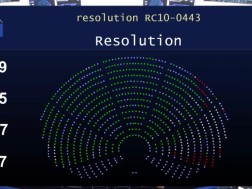
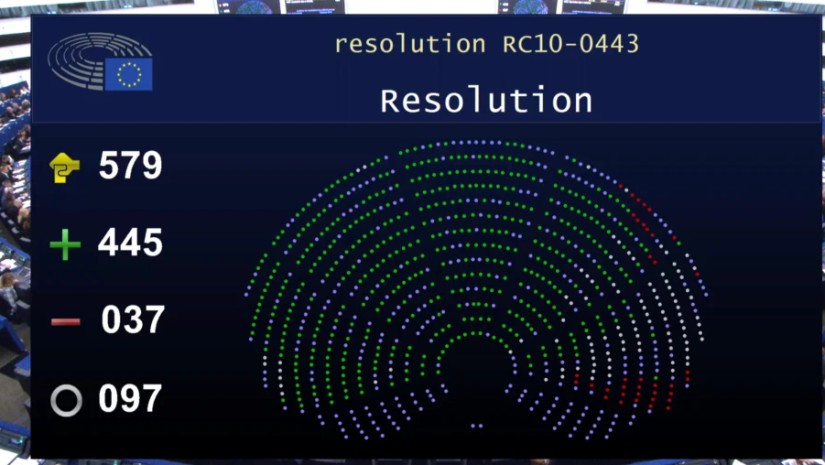

Tbilisi (GBC) - The European Parliament adopted a resolution on Georgia at its plenary session with 445 votes in favor, 37 against and 97 abstentions. Titled “Attempts by the Ruling Party Georgian Dream to Ban Opposition Parties in Georgia,” the resolution was prepared by five political groups - EPP, S&D, ECR, Renew and Greens/EFA. MEPs strongly condemn attempts to ban opposition parties and call for the immediate withdrawal of the constitutional lawsuit. The resolution states that eliminating legitimate political opposition through judicial proceedings is incompatible with democracy and that any attempt to ban political parties would move Georgia away from the EU and hinder progress toward European integration.
MEPs call on the EU and its member states to impose targeted personal sanctions and visa restrictions on individuals responsible for democratic backsliding, violent repression and political persecution. The resolution specifically names Bidzina Ivanishvili, Irakli Kobakhidze, Shalva Papuashvili and Kakha Kaladze. The document also refers to the constitutional lawsuit filed in November 2025 by the Georgian Parliament seeking to ban opposition parties, including the United National Movement, Coalition for Change and Strong Georgia – Lelo. The Federalists were subsequently added to the case, while For Georgia, described in the resolution as the only opposition party represented in Parliament, was added in September 2026.
According to the resolution, the European Parliament also calls for:
- the immediate release of all political prisoners and those detained for peaceful protests, including Elene Khoshtaria, 2025 Sakharov Prize laureate Mzia Amaglobeli, Mikheil Saakashvili, Giorgi Baramidze and Nika Melia;
- the dropping of charges in politically motivated “sabotage” cases;
- the repeal of provisions allowing disproportionate restrictions on banned parties and individuals;
- an end to the use of legislation and state institutions to silence political opponents;
- the removal of obstacles facing European political foundations, including the Konrad Adenauer and Friedrich Naumann foundations.
The resolution describes the situation in Georgia as increasingly deteriorating in terms of democracy, media freedom, human rights and the rule of law. MEPs characterize the attempts to ban opposition parties as part of what they describe as a broader Georgian Dream strategy to establish a one-party regime by eliminating political pluralism, comparing it to the models of Russia and Belarus. The European Parliament also reiterates its support for the Georgian people’s European aspirations and recalls its previous warnings that banning existing political parties would move Georgia away from the EU and hinder any steps toward EU membership. It also rejected two amendments submitted by Tomasz Froelich and Petar Volgin that sought to remove references to the alleged one-party strategy and targeted sanctions from the resolution.