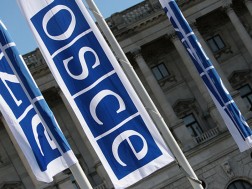

Tbilisi (GBC) - “European countries should drop their opposition to Georgia’s bid for the chairpersonship of the Organisation for Security and Co-operation in Europe (OSCE), or risk leaving the body without leadership in 2027,” former British diplomat Ian Proud has warned in an opinion piece published by Responsible Statecraft.
According to Proud, 14 European states oppose Georgia’s candidacy without citing specific reasons. Meanwhile, Türkiye is blocking Cyprus’s bid, deadlocking consensus over the organisation’s rotating leadership.
“Europeans need to drop their opposition to Georgia’s bid to save the OSCE from crisis,” Proud writes.
In the article, the author also examines Georgia’s foreign policy, arguing that Tbilisi’s cautious approach to relations with Russia, shaped by the 2008 war experience, could prove an asset at the helm of the OSCE.
“The delicate geopolitical balancing act that Georgia must maintain in its relations with Russia is precisely why it would make a good OSCE chair,” the former British diplomat writes.
Proud also addresses the deterioration in relations between Georgia and the European Union, noting that European opposition stems in part from Tbilisi’s decision not to join economic sanctions against Russia. He stresses that Georgia officially supports Ukraine’s sovereignty and territorial integrity, adding that the United States, Canada, Ukraine, and Russia are not opposing Georgia’s candidacy.
“The notion that Georgia is an ally of Russia simply because it does not wish to expose itself to the risk of another devastating war is, frankly, absurd,” Proud writes.
The article also speaks positively of Georgia’s economic growth and reforms, citing them as evidence of the country’s institutional capacity, and notes that Georgia assumed the chairmanship of the OSCE Forum for Security Co-operation in April 2026. Proud warns that failure to reach agreement on the chairmanship could paralyse the OSCE’s work, including on matters related to the war in Ukraine.
Ian Proud served in the British Diplomatic Service from 1999 to 2023, including a posting at the British Embassy in Moscow, and is currently a non-resident fellow at the Quincy Institute.