Natia Turnava Participated in the IMF’s Governor Talks
The discussion takes place as part of the IMF–World Bank Annual
Meetings and provides a platform for sharing successful economic
policy experiences. Each year, selected representatives from five
regions of the world take part in the initiative, with sessions
moderated by the directors of the IMF’s regional departments. This
year, in addition to Georgia, Governor Talks sessions were held with
the governors of the central banks of four other countries: France,
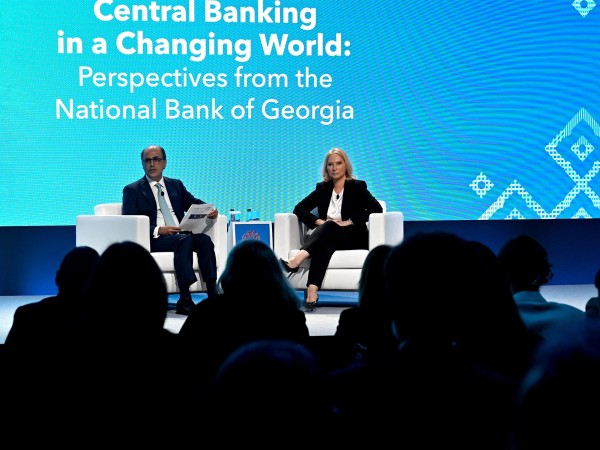
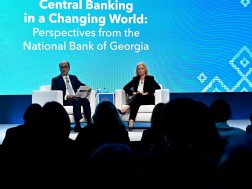
South Korea, Venezuela, and Rwanda.The session featuring the NBG
Governor, titled “Governor Talks: Central Banking in a Changing
World: Perspectives from the National Bank of Georgia,” was
moderated by Jihad Azour, Director of the IMF’s Middle East and
Central Asia Department.One of the key topics discussed was how
central banks manage monetary policy and keep inflation expectations
anchored amid successive, persistent shocks that have had a
significant inflationary impact on most countries.According to Natia
Turnava, maintaining credibility is the main challenge in such
circumstances. Anchoring inflation expectations in such an uncertain
environment therefore requires highly credible and clear policy
actions.“In this regard, Georgia has indeed achieved quite positive
results. We have managed to keep inflation expectations anchored
throughout this period, despite all external challenges, and have
strengthened our resilience. Over the past three to four years, we
have kept inflation below the target in 2023-2025, average headline
inflation stood at 2.5%, below our target of 3%. Even now, as we face
the impact of an external energy shock, the conflict in the Middle
East, and the associated rise in fuel prices which is transmitted
immediately to our economy because Georgia is an energy-importing
country-headline inflation has exceeded the target, reaching 5.6%.
However, key informative indicators, such as core inflation and
services inflation, remain close to the target, at 3.5% and 3.7%,
respectively, indicating that inflation expectations remain firmly
anchored,” Natia Turnava noted.The NBG Governor also highlighted
that Georgia has maintained strong economic growth alongside low
inflation, describing this as a particularly favorable and distinctive
combination.According to Natia Turnava, economic growth has been
driven primarily by highly productive industries that do not generate
inflationary pressures through domestic demand.“This allows us to
take a more proactive approach. That is why we have adopted a
pre-emptive, cautious, and vigilant stance. This was also the case
during the COVID-19 pandemic, when the National Bank of Georgia was
among the first to respond swiftly by tightening monetary policy.
Later, we were again among the first to begin easing policy as the
shocks started to subside. Even during a period of low inflation, we
chose to maintain the policy rate above its neutral level because of
the escalation of new geopolitical conflicts in our region. When the
conflict in the Middle East began, we were well prepared, but we once
again took a pre-emptive approach. In May 2026, we raised the policy
rate by 0.25 percentage points, sending a strong signal to financial
markets,” Natia Turnava added.As she further explained, the aim of
these decisions was to keep inflation expectations stable and prevent
second-round effects to the greatest extent possible.“The
effectiveness of this approach is confirmed by indicators of
sticky-price inflation, which remain close to the target,” the NBG
Governor stated.During the session, Natia Turnava also highlighted the
importance of central bank independence and a robust governance
framework. In her assessment, institutional independence is not
limited to legislative guarantees; above all, it means making timely
and credible decisions within the central bank’s mandate and
ensuring that its primary objectives are achieved.The NBG Governor
also emphasized the importance of cooperation with the International
Monetary Fund. She noted that this cooperation had helped identify
opportunities to further strengthen the governance framework and had
led to significant steps toward institutional
development.De-dollarization was another key topic of the discussion.
According to Natia Turnava, maintaining macroeconomic stability and
strengthening confidence in the national currency are crucial to
achieving sustainable progress in de-dollarization. As a result of the
NBG’s consistent policies and the accompanying macroeconomic
stability, the dollarization of deposits and loans has declined by
approximately 25–30 percentage points over the past ten years.At the
conclusion of the session, Jihad Azour, Director of the IMF’s Middle
East and Central Asia Department, congratulated the NBG Governor and
her team on the results achieved in recent years.“I would like to
congratulate you and your team on maintaining macroeconomic stability
while navigating one of the most challenging environments of the past
few years,” Jihad Azour noted.He emphasized that the NBG’s efforts
to build up economic buffers were an important prerequisite for
resilience to external shocks. He also highlighted Georgia’s
progress in modernizing its financial sector, developing financial
technologies, and introducing financial innovations.Jihad Azour spoke
positively about the performance of the Georgian economy, noting that
its results had exceeded all projections. He also praised the NBG’s
capacity to manage various shocks and commended the decisions taken in
the area of monetary policy.
1792150689