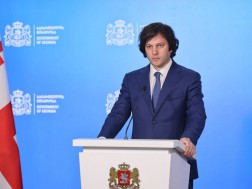
NBG increases refinancing rate to 8.25%
The escalation of geopolitical situation in the Middle East and the
prolonged substantial disruptions to shipping through the Strait of
Hormuz have created another supply-side driven inflationary shock to
the global economy. The sharp increase in the prices of raw energy
resources on international markets has already been reflected in
rising global inflation. At the same time, the geopolitical situation
is disrupting international transportation and heightening the risks
of supply chain disruptions. This, in turn, increases production
costs, which could become an additional source of inflation. The
direct effect of the aforementioned increase in oil prices has already
been reflected in fuel prices in the Georgian market. As a result of
the combined direct and indirect effects of these supply shocks,
headline inflation deviated from the 3 percent target in April,
reaching 5.9 percent. At the same time, relatively sticky prices
measures, which better capture long-term inflationary processes and
inflation expectations, have recently accelerated, making the risks of
a second-round effects more pronounced. However, despite the
acceleration, they still remain close to the target. In particular,
core inflation (excluding food, energy and tobacco) stood at 3.2
percent in April, while services inflation was 3.7 percent.Despite
severe geopolitical shocks, the Georgian economy remains resilient and
economic growth stays high. According to preliminary data, economic
activity grew by 10.7 percent in March 2026 and by 9.1 percent in the
first quarter. At the same time, high-productive sectors remain a key
driver of economic growth, which partially offsets demand-side
inflationary pressures.The NBG's updated central scenario assumes that
the ongoing war in the Middle East will end in the second quarter.
However, this assumption is conditional and subject to high
uncertainty. Even if the geopolitical situation indeed de-escalate
during this period, the pace of recovery in global supply capacity is
subject to additional uncertainty. Consequently, high inflationary
risks are more pronounced. However, there is also a possibility that
the geopolitical situation will de-escalate more quickly than in the
central scenario. Therefore, the Monetary Policy Committee (MPC), in
addition to the central scenario, considered both high and
low-inflation risk scenarios.In the event of the realization of the
high-inflation risk scenario, fundamental processes require a higher
trajectory of the monetary policy rate than the central scenario. The
high-inflation scenario assumes a more prolonged and intensified
geopolitical situation. Against this backdrop, commodity prices in the
international market will increase further and the disruption of
supply chains will become widespread. As a result, the supply-side
inflationary shock would exacerbate in Georgia, amplifying
second-round effects, and ultimately inflation would be higher than in
the central scenario.On the other hand, under the low-inflation risk
scenario considered by the MPC, the realization of the risks would
allow a faster normalization of monetary policy stance compared to the
central scenario. A rapid de-escalation of the severe geopolitical
tension in the Middle East would ease price pressures in international
commodity markets. At the same time, the risks of disruptions to
global supply chains would decline significantly, which would be
reflected in lower international transportation costs and, ultimately,
a moderation of global inflationary pressures.As a result of the
ongoing macroeconomic analysis and consideration of existing risks,
the MPC considered it optimal to increase the monetary policy rate by
0.25 pp to 8.25 percent. This decision is aimed at keeping inflation
expectations firmly anchored at the target. The moderate tightening of
monetary policy, in turn, reduces the risks of second-round effects
and aims to ensure that, once the supply-side shock dissipates,
inflation converges swiftly to the 3 percent target. The NBG continues
to closely monitor ongoing developments and the intensity of their
transmission to the domestic market. If inflationary shocks stemming
from geopolitical tensions become even more prolonged and/or their
magnitude would amplify the risks of second-round effects, the MPC
will continue to moderately increase the monetary policy rate.
Thereafter, once the inflationary shock dissipates, the NBG will begin
a gradual normalization of the policy stance.The next meeting of the
Monetary Policy Committee will be held on June 17, 2026.
1778067759