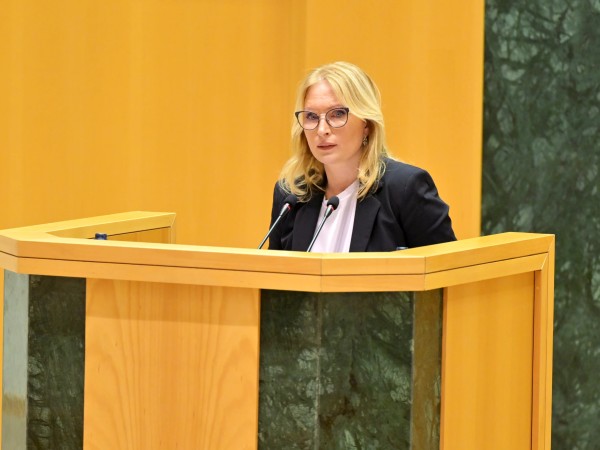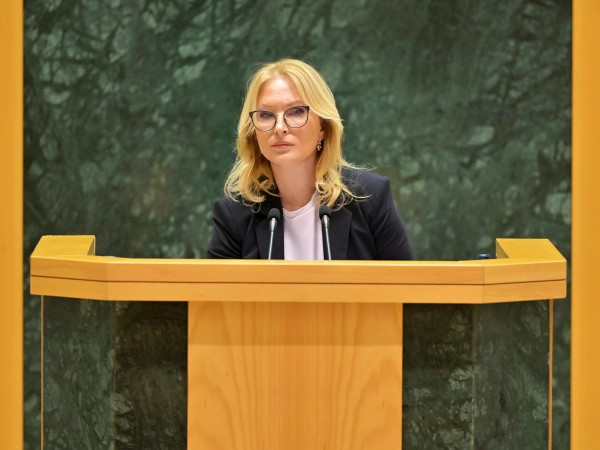
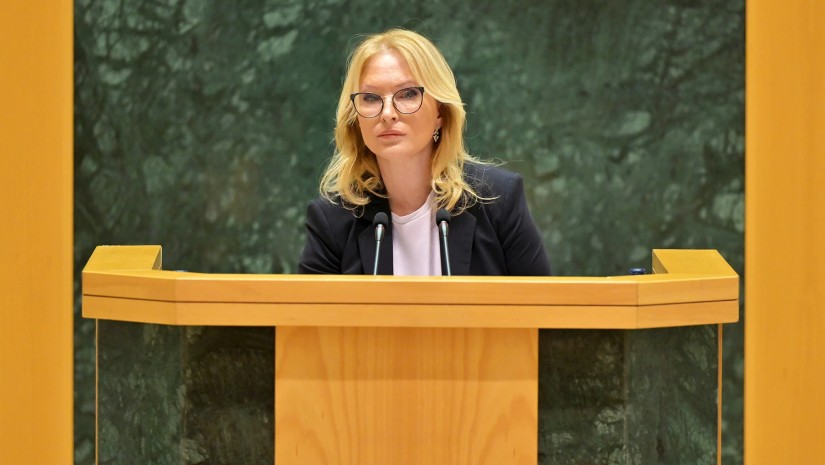

Tbilisi (GBC) - The Parliament of Georgia considered and adopted the draft resolution of the Parliament of Georgia "On the 2025 Annual Report of the National Bank of Georgia," which was presented to the legislative body by the Governor of the National Bank of Georgia (NBG), Natia Turnava.
The NBG's report includes an overview of monetary, foreign exchange, and supervisory policies, as well as audited financial statements.
In her report, Natia Turnava reviewed the main directions that guided the NBG in 2025. She began her speech by discussing the core objective of the NBG price stability and noted that the average annual inflation in 2025 amounted to 3.9 percent, while the indicators reflecting long-term inflation expectations, including core and services inflation, remained close to the target level.
"Despite global challenges and the impact of developments in the Middle East, inflation expectations are manageable, which was facilitated by the monetary policy implemented by the NBG. For this very purpose, in response to the current situation, in May 2026, we increased the monetary policy rate by 0.25 percentage points to 8.25 percent, so that once supply-side shocks dissipate, inflation can quickly return to the target level of 3 percent," stated Natia Turnava.
The Governor of the NBG also focused on the positive trends regarding economic growth and macroeconomic stability.
"Despite severe geopolitical shocks, the Georgian economy maintains its resilience, and economic growth remains high. In 2025, the current account deficit narrowed to a historically low 2.6 percent of GDP, while foreign direct investment increased by 7.6 percent year-on-year to 4.4 percent of GDP. Strong macroeconomic fundamentals enabled us to significantly replenish international reserves. By the end of 2025, international reserves reached USD 6.16 billion, and in February 2026, they hit a historic maximum of USD 6.65 billion," noted Natia Turnava.
Within the framework of the report, the Governor of the NBG also spoke about the measures taken to reduce financial dollarization, noting that as of April 2026, the dollarization of loans had decreased to 42.5 percent, and the dollarization of deposits to 46.6 percent.
Natia Turnava drew attention to the resilience and profitability of the banking sector, noting that by the end of 2025, the credit portfolio of the banking system, excluding the exchange rate effect, had increased by 14 percent, while the return on equity amounted to 22.3 percent.
During the report, the NBG Governor also discussed the measures implemented in the following areas: consumer rights protection, the development of the securities market, strengthening the supervisory framework of the pension fund, upgrading payment infrastructure, supervision of virtual asset service providers, and the development of financial technologies.
According to her statement, in 2025, the NBG actively continued to deepen international cooperation at the regional and global levels, which is crucial for Georgia's positioning as a regional financial hub.
Following the conclusion of the report, the Governor of the National Bank of Georgia answered questions from the Members of Parliament.