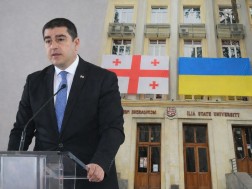
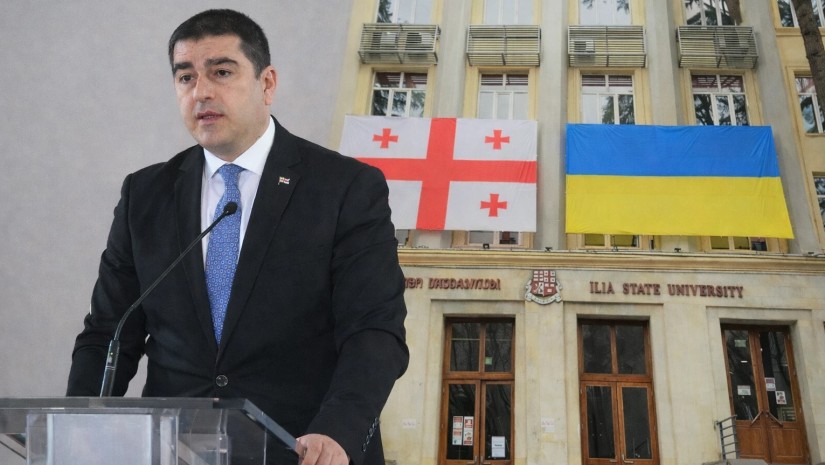

Tbilisi (GBC) - The Georgian government has drastically reduced Ilia State University’s (ISU) student admission quota, sparking sharp political controversy and raising questions about the institution’s future. A newly issued government decree cuts the university’s bachelor’s admission capacity from 4,207 students to just 300, a 92% reduction for the upcoming academic year.
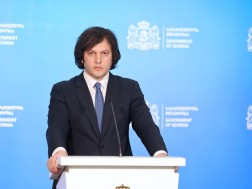
Against this backdrop, the Speaker of Parliament, Shalva Papuashvili, framed the situation as politically motivated and accused protesting ISU representatives of aligning with former president Mikheil Saakashvili. According to Papuashvili, the interests of Saakashvili’s political team stand behind the ongoing resistance to the reforms.
Papuashvili also described the current higher education system as “problematic” and defended the government’s new “one city, one faculty” model. He argued that the reform is “so logical” that only those with “subjective interests” would oppose it.
The new quota decision significantly reshapes Ilia State University, which currently enrolls more than 17,000 students and offers 36 academic programs. As of next year, only 16 programs will remain, most of them with symbolic quotas of 10–30 students, raising doubts about their operational viability.
The government has entirely removed the university’s right to accept students into many of its most popular and strategically important fields, including:
- Social Sciences: Psychology, Sociology, Political Science, International Relations
- Business & Law: All business administration programs (management, tourism, finance) and the Faculty of Law
- Humanities & Arts: Philosophy, Archaeology, Architecture, Film Studies, Music
- Technology: English-language Computer Science program
These cancellations affect some of ISU’s strongest and highest-demand programs, prompting concern from academics and policy observers.
Education experts warn that the sweeping cuts appear to undermine the university’s academic autonomy and could be part of a political effort to weaken one of the country’s leading liberal arts institutions. With most major programs abolished and only narrow specialties remaining, critics say the reforms could destabilize the entire institution.
Some analysts argue that the scale and speed of the quota reductions effectively amount to a restructuring that threatens Ilia State University’s long-term sustainability.