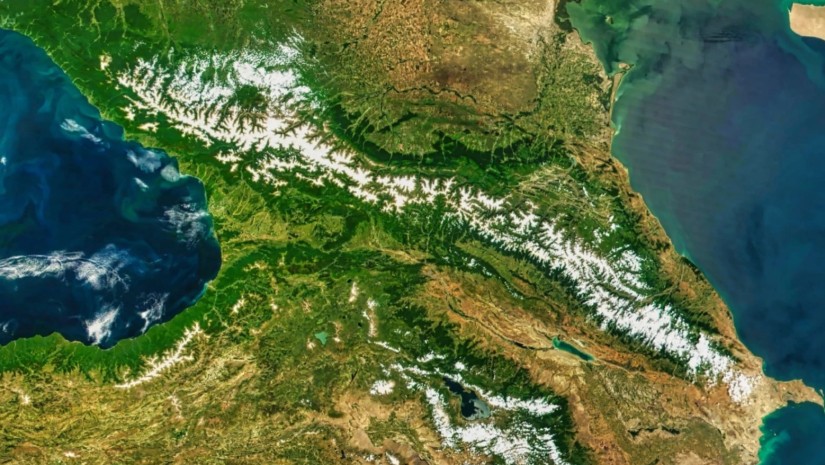

Tbilisi (GBC) – The National Interest has published an analytical study, the authors of which are Inal Sherip and Luke Coffey, calling on the West to change its strategic vision. According to the study, the Black Sea, the Caucasus and the Caspian Sea should be perceived as a single system – the Black Sea-Caspian Region (BSCR).
The authors conclude that Washington should no longer consider this area as a peripheral part, since its stability is directly related to Europe’s energy security.
The Caucasus - Eurasia Economic Bridge
The study emphasizes that the war in Ukraine has accelerated the birth of a new Eurasian order. In this context, the South Caucasus is a key trade and transit corridor connecting Central Asia to European markets.
However, analysts say this function is at risk as long as the North Caucasus remains under Russian dominance. The North Caucasus has been described as a “structural lock” that acts as a “sword of Damocles” on southern transit routes.
Two key scenarios
The authors consider two main scenarios:
- Maintaining Russian control: Russia maintains its power projection and imposes a permanent “risk surcharge” on regional ties, which discourages investment and complicates economic planning.
- Weakening Russian influence: Weakening Moscow’s control over the North Caucasus frees the region from the blockade. This creates the opportunity for the Black Sea-Caspian region to become a fully integrated system, free from external constraints.
The article concludes: “In this order, the protection of key points in the Black Sea-Caspian region becomes a strategic imperative for the West.” The authors urge politicians to start thinking about the region as a unified system now, so as not to miss the prospect of a Eurasia free from Russian influence.