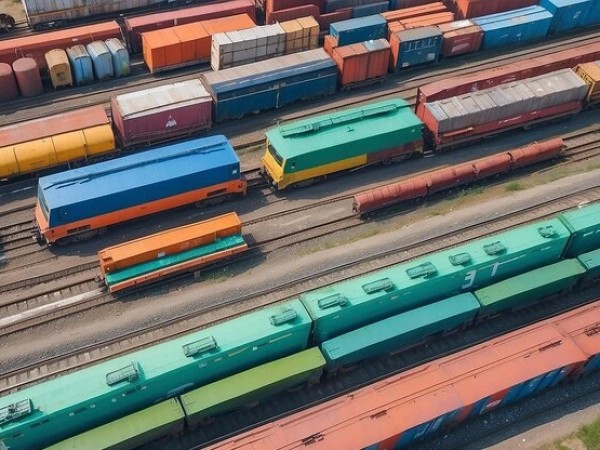
Petroleum products account for 34.7% of rail-transported cargo, while...
In Q3 2026, within the category of international rail shipments, 77.9%
of the total volume consisted of cargo imported into the country,
while 22.1% consisted of cargo exported from the country.In Q3 2026,
the Russian Federation was the country of origin for 22.2% of the
total volume of cargo imported by rail, and Azerbaijan was the country
of origin for 22.1%. The share of each of the other countries of
origin was less than 10% (collectively accounting for 55.7%).In 3Q26,
Armenia was the destination country for 24.4% of the total volume of
cargo transported by rail, followed by Kazakhstan with 8% and the
Russian Federation with 7%; the shares for each of the other
destination countries were relatively smaller (totaling 60.6%).In
3Q26, the distribution of the total volume of transit cargo by
destination country was as follows: 9.2% – Turkey 8.3% –
Netherlands 5.7% – China 1.8% – Italy 1.1% – Ukraine 0.7% –
Romania The remainder was accounted for by other countries. During the
same period, Brazil was the country of origin for 4.8% of the transit
cargo, and Turkey for 3.9%, with the remainder originating from other
countries.During the reporting period, 34.7% of the total volume of
cargo transported by rail consisted of the commodity group comprising
coke and refined petroleum products, while 21.5% consisted of
chemicals, chemical products, and man-made fibers. ...for the
commodity group of rubber and plastic products, while 11.5% accounted
for food products, beverages, and tobacco.In the third quarter, the
distribution by commodity group differed for domestic shipments: 61.4%
consisted of metal ores and other mining and quarrying products, 15.8%
comprised transport equipment, and 14.8% fell under the commodity
group of coke and refined petroleum products.As for international
shipments, the primary goods imported by rail during the reporting
period were coke and refined petroleum products (47.3%), other
non-metallic mineral products (13.7%), food products, beverages, and
tobacco (7.9%), metal ores and other mining and quarrying products
(7.8%), and coal and lignite; Crude oil and natural gas (7.7%), basic
metals (6.5%), chemicals, chemical products, and man-made fibers
(2.5%), products of agriculture, hunting, and forestry (2.5%), wood
and cork products (1.8%), and machinery and equipment (1%); meanwhile,
exports consisted of food products, beverages, and tobacco (25.8%),
chemicals, chemical products, and man-made fibers (24.9%), other
non-metallic mineral products (16.4%), metal ores and other mining and
quarrying products (12.6%), and basic metals (12.5%).According to
Geostat data, in the third quarter of 2026, 78.2% of the total volume
of transit cargo was accounted for by three commodity groups,
specifically: coke and refined petroleum products (35%), chemicals,
chemical products, and man-made fibers (30.8%), and food products,
beverages, and tobacco (12.4%). In the third quarter of 2026, Georgian
Railway transported 708,000 passengers, an increase of 20.2% compared
to the same period of the previous year. During the same period,
passenger turnover reached 164.5 million passenger-kilometers, which
is 13.6% higher than in the corresponding period of the previous
year.In the third quarter of 2026, 619,800 passengers were transported
via domestic services - accounting for 87.5% of the total number of
passengers transported by rail - representing an 8.1% increase over
the figure for the corresponding period in 2025.Additionally, 88,200
passengers were transported via international services, a figure
approximately 5.6 times higher than that of the same period the
previous year. Of these international passengers, 35.5% arrived from
Azerbaijan, 12.6% arrived from Armenia, 36.8% departed toward
Azerbaijan, and 15.1% departed toward Armenia.
1795087111